Copy
Expected: the exact command enters the clipboard with no shell prompt or extra characters.
Verify: compare the copied text with the command shown on this page. No package has run yet.
Install
Installation has four states: copy, run, configure, and first result. A clipboard notification is not a completed install, and a populated prospect record is not an approved outreach target. Keep every transition visible.
npx -y @okki-global/okki-go-taroball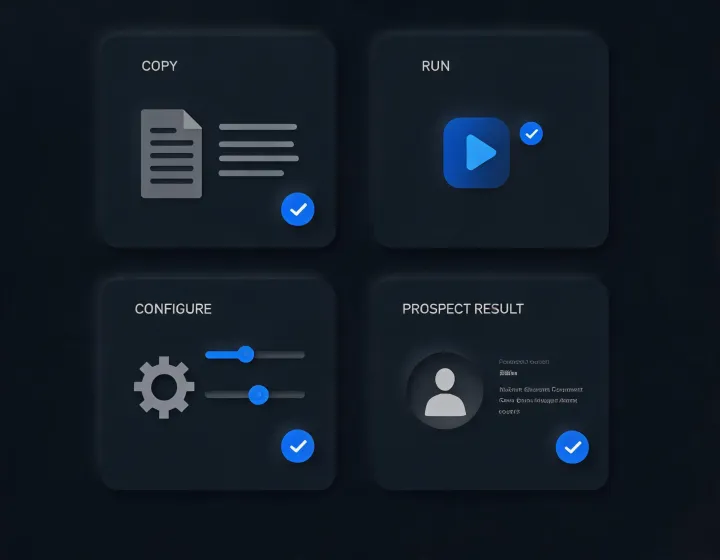
Expected: the exact command enters the clipboard with no shell prompt or extra characters.
Verify: compare the copied text with the command shown on this page. No package has run yet.
Expected: a supported terminal displays the package prompt and completion or error output.
Verify: inspect runtime requirements, requested access, package version, network behavior, and errors before continuing.
Expected: approved data connections use minimum scopes and secrets remain outside prompts and repositories.
Verify: list external services, credential owner, storage location, expiry, revocation, output destination, and deletion path.
Expected: a small known cohort returns company identity, professional role, source context, timestamp, contact state, and unresolved fields.
Verify: check exclusions and require a named human decision before CRM activation, drafting, or sending.
Use a controlled environment first. Record the operating system, runtime version, package version, test date, exact command, sanitized output, and the stage where an error appears. Never publish tokens, cookies, private contact exports, or logs containing credentials.
Confirm provider terms, permitted purpose, field provenance, observation date, rate limits, retention, correction, suppression, and deletion. Browser automation may expose useful context while creating fragile selectors and platform-policy risk; an API may be more repeatable while adding cost and schema dependencies.
Include known positives, known exclusions, stale roles, shared company names, and one incomplete record. Score entity identity, role evidence, freshness, source visibility, contact verification state, exclusion handling, and reviewer confidence separately.
Define the ICP, allowed sources, prohibited uses, credentials, output destination, retention window, and owner of the final review decision.
Grant least privilege, keep secrets in the runtime store, and confirm where intermediate company and professional records are written.
Compare known records, preserve unknowns, measure false matches, and distinguish unavailable data from incorrect data. Do not compress these states into one advertised accuracy figure.
Keep research and sending separate. Review relevance, contact status, suppression, opt-out handling, applicable regional requirements, SPF, DKIM, DMARC, and sender reputation.
Follow the package’s documented uninstall path, revoke connected credentials, remove temporary outputs, and retain only the audit information your policy requires.
The button copies the command. You still decide when and where to run it, which services to connect, and whether the first result passes review.
npx -y @okki-global/okki-go-taroball