Examples
Four bounded prospecting tasks
Choose the operating question before choosing the data volume. Each example below defines a decision, an input boundary, a review record, and a stopping condition so an agent result does not silently become permission to contact someone.
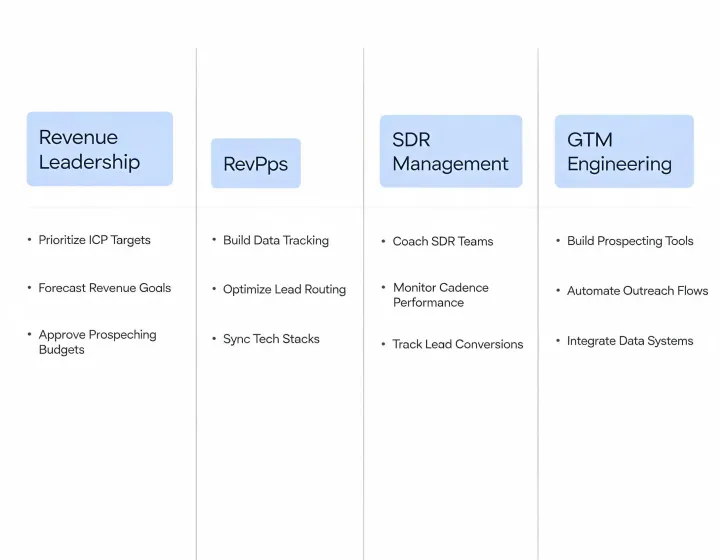
Open the workflow that matches your role
Revenue leadership — validate a market thesis
Describe the industry boundary, geography, company-stage proxies, trigger window, and disqualifiers before discovery. Ask for a small set of recognizable accounts with the reason each one entered the set.
Review: Remove the trigger signal and ask whether the account still fits. A funding round, executive appointment, or hiring burst is context, not proof of urgency or budget. Record false positives and changed criteria so the next run does not move the goalposts.
RevOps — enrich without losing provenance
Resolve legal name, operating name, domain, subsidiary relationship, and location before updating CRM. Preserve source date, provider, transformation rule, previous value, and an explicit unknown state when sources disagree.
Review: Confirm that every changed field can be explained and reversed. Waterfall enrichment can improve fill rate while multiplying source terms, costs, timestamps, and correction paths; a single source is simpler but may leave more gaps.
SDR management — prepare a relevant brief
Return professional role evidence, company context, dated activity, open questions, and a verification state for any discovered contact address. Do not allow the research task to send a message.
Review: Separate fact from inference and edit any personalization claim. Check suppression, opt-out language, applicable regional requirements, platform policy, and SPF/DKIM/DMARC readiness before an approved sending system is considered.
GTM engineering — evaluate the agent boundary
Run with a test identity and known cohort. Observe package prompts, runtime requirements, secrets, external services, permission scopes, network calls, rate limits, retries, logs, output schema, destination storage, and uninstall guidance.
Review: Force a missing credential, conflicting identity, rate limit, and unavailable source. The workflow should fail visibly without leaking a token, inventing a field, or treating an incomplete result as approved.
Run one question, then inspect every field
Copy the installer and start with the example whose acceptance test your team can already answer.
npx -y @okki-global/okki-go-taroball